How to Use LeetCode Tags Efficiently Instead of Random Practice
What FAANG Candidates Know About Tags That You Don't

If you’re reading this, you’re probably stuck trying to finish every LeetCode tag like it’s some kind of challenge.
You keep solving problems, but when a new problem comes, you still feel blind. You know how to solve the questions you already saw, but you don't always know what to do with a completely new one.
This is where LeetCode tags can actually help.
What we’ll cover
LeetCode Tags: What to Pick
LeetCode Tags: How to Filter the Questions
How to Practice Without Becoming Dependent on Them
Bonus: Read the Constraints Before You Solve (don’t skip this)
1. LeetCode Tags: What to Pick
LeetCode has around 71 tags covering different topics, algorithms, and techniques. You definitely don't need to randomly click every tag and start solving hundreds of questions.
Here’s the reality:
LeetCode tags aren’t a full course plan.
You don’t have to solve problems from Tag 1 to Tag 71 to get good at data structures and algorithms.
Some tags are much more useful as a foundation because they appear everywhere and connect with many other topics.
Note down this tags -
Array
String
Hash Table
Dynamic Programming
Depth-First Search
Binary Search
Tree
Breadth-First Search
Two Pointers
Heap (Priority Queue)
Graph Theory
Binary Tree
Stack
Sliding Window
Backtracking
Linked List
This isn’t a magical “must solve everything” checklist. Think of them as high-leverage areas that give you the highest return on your time.
Also, don't sweat it when a single problem has multiple tags.
A problem can easily feature Array + Hash Table + Two Pointers.
You don't need to treat that as three completely separate concepts to master.
Tags just show you the ingredients inside the problem. Usually, one tag is the core breakthrough and the others are just supporting setup.
For instance, a problem might be stored under Array simply because that’s the data format you're handed, but the actual trick you need to learn is hashing.
2. LeetCode Tags: How to Filter the Questions
Every tag has a many number of questions.
You can click Array and find 100 problems are there.
You obviously can't solve all of them.
This is where you have to filter !
Start by looking at popularity, acceptance rate, difficulty, and whether the problem actually shows up in real interviews.
High popularity points you toward the high-yield questions everyone faces. A solid acceptance rate keeps you from wasting hours on poorly worded, frustrating edge cases too early.
But don't treat either number as a truth machine.
Keep an eye on acceptance rates. If you're just starting out (and let's be honest, I know exactly why you're reading this...), stick to the high-acceptance questions to build momentum.
Also, ignore that generic influencer advice claiming you only need to "solve 3 to 5 problems."
The magic number is simply whatever it takes for the core pattern to finally click in your head.
3. LeetCode Tags: How to Practice Without Becoming Dependent on Them
LeetCode tags are a double-edged sword. They are very useful when you’re first learning a concept, but they easily turn into a spoiler.
If you’ve just cleared ten Sliding Window questions in a row, you already know the trick to the eleventh before you even read the prompt.
Of course you solved it. The platform practically gave you the answer key.
Real interviews don’t give you clues. A recruiter is never going to hand you a problem and say, "Here is a medium Sliding Window question, good luck. 😊"
The strategy is simple: keep tags visible when you are learning a topic, but hide them when you are testing yourself.
Grab a random problem and force yourself to figure out the approach before peeking at the label.
Once you finish, check the tags to audit your thinking. You might realize you used Two Pointers when the optimal approach was Binary Search.
That specific moment of friction is where real learning happens.
You also need to randomize your practice. Instead of grinding five Array problems back-to-back, bounce around.
Try an Array, then a Tree, then a Binary Search, and then a Heap.
This forces your brain to actually think rather than just coasting on the muscle memory of the last problem you did. This chaotic mix is exactly what a real interview feels like.
Ultimately, the pipeline is simple: use tags to learn, mix problems to test, and finally, solve blindly.
4. Bonus: Read the Constraints Before You Solve
Here is a quick bonus for you , always look for constraints.
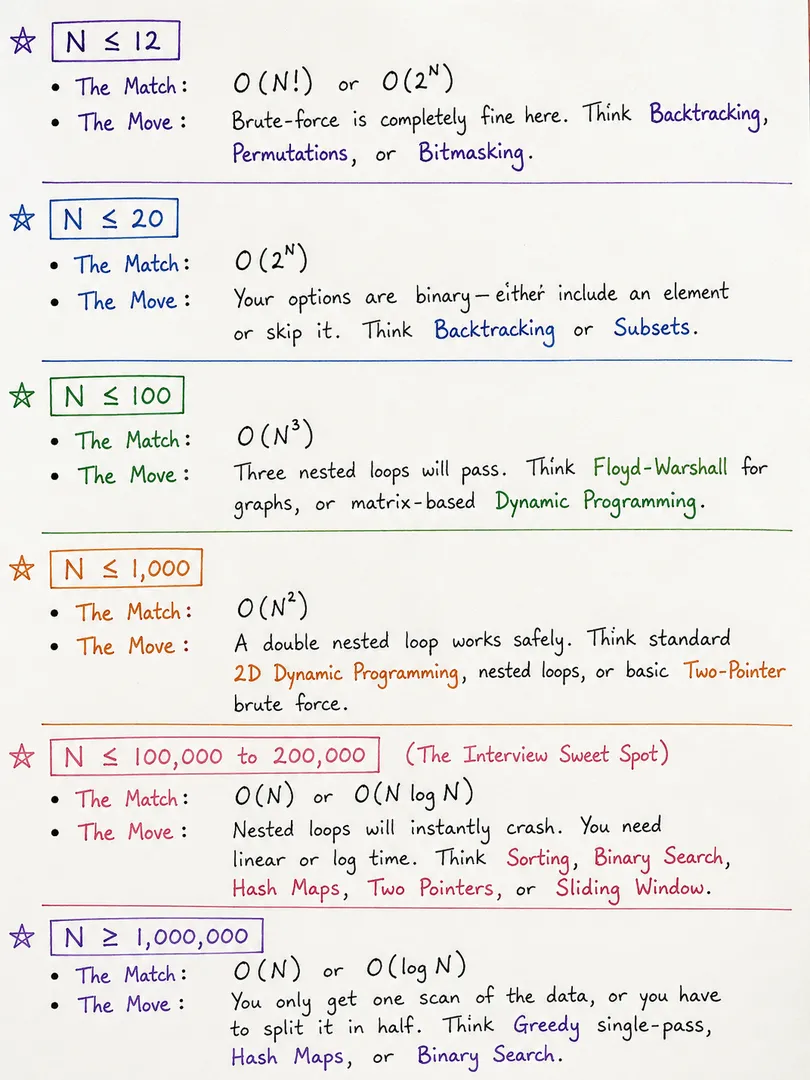
Input size (N) predicts the required algorithm because LeetCode’s 1-second time limit restricts operations to approximately 100 million.
Analyzing N allows for the immediate elimination of inefficient approaches before coding.
Learn with the tag, practice without it, and solve like it's the real thing, because it will be. No clues, no labels, just you and the problem.
Thanks for reading this .
debjyoti2409@gmail.com • Contributor
Discussion (0)
No comments yet. Be the first to start the discussion!