How to Actually Learn Backend in 2026
The skills that actually matter when tutorials end and real backend engineering begins.

If you are learning backend, then this content is helpful for you. Take 10 minutes to read it. It will discuss how you need to learn backend in 2026. Stop wasting time on 10-minute YouTube videos where you watch someone build something but never build it yourself.
The backend world moves fast.
You’re dealing with databases, cloud services, AI tools, distributed systems, and real production apps.
Learning doesn’t stop after college either.
In Stack Overflow’s 2025 survey, 69% of developers spent time learning a new coding technique or language in the past year.
Yet here’s the hard part.
Many of Indian students get rejected in interviews because they never actually studied backend the right way.
Its not not about finishing a course , its about right mindset while learning backend .
This content is built for the interview round , not resume screening.
(If you need help with resume project writing, follow this guide: How to write project bullet points in resume )
System Design is More Important Than You Think
You crushed LeetCode.
You memorized sorting algorithms.
Interview says: "Design a URL shortener."
Your mind goes blank.
In 2026, system design is unavoidable for entry-level backend roles. You don't need to master it like seniors. Just understand the foundations.
What actually matters:
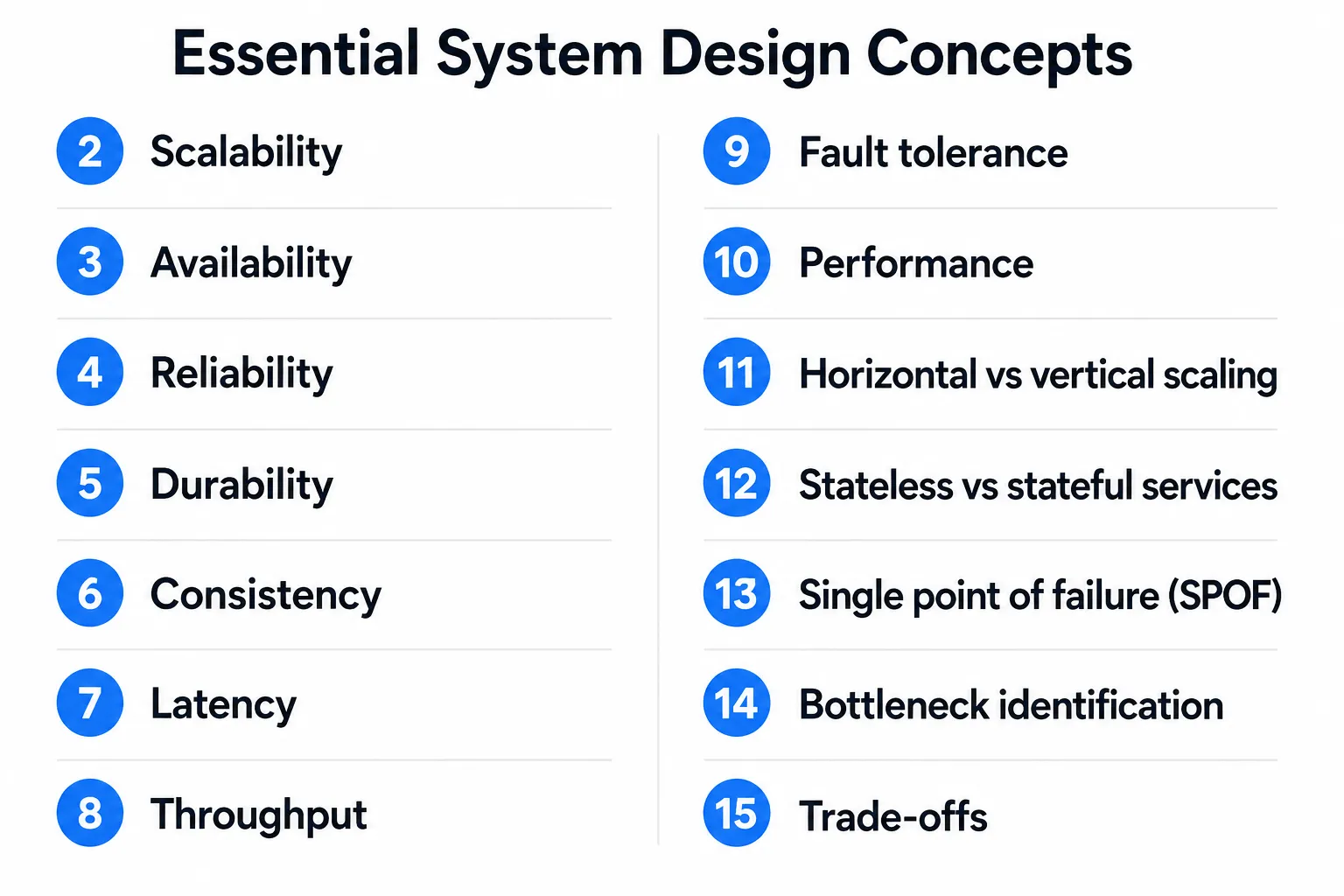
System design is about making trade-offs when things break under load. It's about knowing why your cache helps but where it hurts. It's about looking at a problem and saying "if 10,000 users hit this at once, what breaks first?" That's the intuition you need, not advanced architecture.
Free resource to start:
GeeksforGeeks System Design Tutorial
Most important: apply this in your projects. Build something. Add caching. See what breaks under load. That's system design.
Want to go deeper later?
You can check this out after you’re done:
System Design in RAG era 2026
You are not deploying properly !
You build a backend API.
Works perfectly on your laptop.
Friend tries to run it.
It crashes.
Environment variables are missing.
No logs to see what broke.
This happens to every junior developer. Nobody warns you about it because college doesn't make you deploy anything.
The gap between "code that runs locally" and "code running in production" is massive. You need to understand containers, environment setup, and logging. This isn't DevOps. This is just survival for backend engineers.
Learn Docker in an afternoon: 49 Min system design course
Then deploy something free on Railway or Vercel
Break it. Fix it. Now you understand production.
Most important: your next project must live on a real server with a real URL. That experience teaches you more than any course.
Debugging Production Issues Feels Like Guessing
Ask yourself a question , "Can I debug alone if something breaks on production ?"
If Not, see why .
Error message is useless.
No logs. No visibility. You're throwing darts.
Senior developers debug faster because they know how to read the evidence.
Before learning fancy monitoring tools, learn to read the logs your application already produces.
Start with:
Log levels:
INFO,WARN,ERROR,DEBUGTimestamps and request IDs
HTTP status codes
Stack traces
Error messages and error causes
Following a request through your backend
Beginner resource:
JavaScript/Node.js (or whatever you are using) debugging & logging tutorials on YouTube
Then practice: deliberately introduce bugs into your API and debug them only by reading the logs.
Once you're comfortable with this, move to centralized logging with ELK/Loki, metrics with Prometheus + Grafana, and distributed tracing with OpenTelemetry.
Most important: next time something breaks, don't immediately restart the server.
Read the logs. Follow the evidence. Find the root cause.
That's debugging
Caching : Why is your API slow
This part is simple . skip it if you're already familiar with caching.
You don't need caching theory. You need to know: when your database gets hammered with the same queries, cache those results. Redis does this in seconds. Response time drops 80%.
That's it. That's the skill. Spend 2 hours learning Redis basics and build one project with it. You'll see why it matters instantly. Most important: if you've built something with a database, you should know where caching helps.
Security is Not Extra , Its Baseline
Security does not only mean password hashing, everyone does it.
Interviews expect you to think about SQL injection, authentication, secure headers.
Not as an afterthought. From the start.
Good news: OWASP has everything free. Learn the top 10 vulnerabilities. It's not boring if you think of it as "ways your app gets hacked" because that's exactly what it is.
OWASP Top 10 (bookmark this)
Most important: your next project should have password hashing, input validation, and HTTPS. If you can't explain why each matters, you're not ready for interviews.
Before Your Next Interview
☐ System design basics covered? GeeksforGeeks System Design
☐ Deployed something? Use Railway
☐ Know how to debug? Read Backend Monitoring
☐ Security basics? OWASP Top 10
That's it. You're ahead of 90% of students applying.
debjyoti2409@gmail.com • Contributor
Discussion (0)
No comments yet. Be the first to start the discussion!